
Ceiling Fans Adelaide: Licensed Installation
- 2024 Emerging Business of the Year (MEA SA)
- 13+ years in the trade
- 24/7 electrician
- Licensed & insured · PGE 229 469
A ceiling fan must be wired by a licensed electrician and fixed to something strong enough to carry its weight and movement. A swap for an existing fan is quick. A new fan needs wiring, a solid mounting point and a switch. We supply wiring and fitting, test the fan for wobble and noise, and show you how it works before we go.
Ceiling fans are a steady job for home owners: over 100 jobs in the 12 months to October 2026 involved a ceiling fan.
Replacing a fan or adding a new one
There are two very different jobs hiding under the same name, and it helps to know which one you have.
- Like-for-like swap: an old fan comes down and a new one goes up on the wiring and mounting that already exist. This is the shorter job.
- New fan where there is a light: the light fitting comes out and a fan with a proper bracket goes in. The ceiling needs checking first.
- New fan where there is nothing: new cable, a new switch and a solid fixing point are needed. This is a bigger job.
- Outdoor or alfresco fan: needs a fan rated for the conditions and protection against weather and damp.
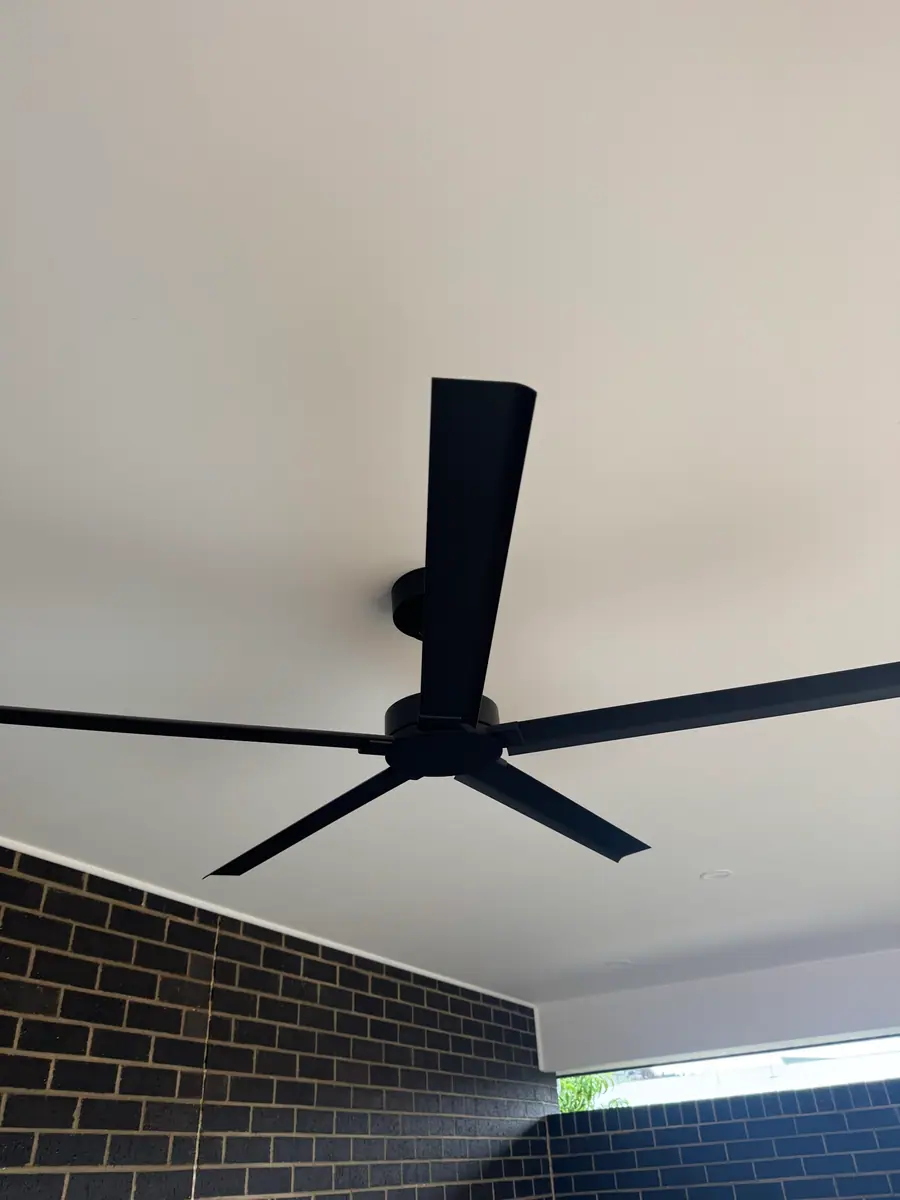
Can you install a fan I have already bought?
Yes. We can fit a fan you supply if it suits your ceiling and wiring. Before we start we check:
- The weight and size of the fan against the ceiling and the fixing point.
- Whether the ceiling height suits the fan, and whether it needs a flush mount or a longer rod.
- That the fan is rated for where it is going. A fan for a covered outdoor area needs to be made for it.
- That the parts are all in the box, including the bracket, and that the fan is in good condition.
- The wiring and switch at the ceiling, including whether the switch or control suits the fan.
If something does not suit, for example the bracket is too light or the fan is not rated for the spot, we will tell you before we start. Our guide on installing a ceiling fan yourself explains why the wiring side is licensed work.
What the installation involves
- We check the ceiling type, the ceiling height and what is above it.
- We choose the mounting point and confirm the ceiling can carry the load.
- Power is turned off at the switchboard and the old fitting is removed.
- The fan is mounted on a rated bracket, wired and balanced.
- We test every speed, the direction switch and any light, and show you the controls.
A fan that is not fixed properly can wobble loose over time, so we never hang a fan from the plasterboard alone.
A like-for-like swap is often done in an hour or two. A new fan with new wiring takes longer, and several fans in one house can be done in a single visit. We will give you a realistic estimate once we have seen the ceiling.
No fan point or wiring? New cable and a fan-rated support
If there is no light or fan point in the ceiling, there is nothing to connect to. We run new cable from a suitable circuit, fit a new switch or control, and install a support rated for a moving fan. This is licensed electrical work, and where we cut into a ceiling we leave it as tidy as we can.
A moving fan puts a steady pull and a side-to-side push on its fixing. Plasterboard and a light-duty hook will not hold that for long, so a fan needs a proper fan-rated bracket, fixed to a timber joist or a purpose-made brace.
This is the main reason we advise against a DIY fan install, even for a confident handyman. The electrical side must be done by a licensed electrician, and the mechanical side is where bad jobs fail. Wobbling, clicking or humming are usually signs of poor fixing or an unbalanced blade.
Choosing a fan that suits the room
- Blade span: bigger rooms need bigger fans. A small fan in a large room will not move much air.
- Motor type: DC motor fans are usually quieter, often have more speed settings and use less power. AC motor fans are often cheaper to buy. Both are wired by your electrician, so choose on noise, controls and budget.
- Ceiling height: low ceilings need a flush-mount fan. Tell us if you have a raked or high ceiling and need a longer rod.
- Controls: a wall switch, a handheld remote or a wall-mounted control. Remote receivers need space in the fan body.
- Reverse mode: many fans can spin the other way in winter to gently circulate warm air.
- A built-in light: many fans come with one. We can wire the fan and the light to separate wall controls, so you can use either one on its own. If you want to dim the light, check that the fan supports it.
Fans also work well alongside an air conditioner. If you are planning both, we can look at them together.
Safety and what to ask your electrician
Fan wiring must be done by a licensed electrician. Hoile Electrical holds SA electrical licence PGE 229 469.
- Can I see your licence number?
- What will the fan be fixed to?
- Will you balance and test the fan before you leave?
- Do I need a new switch or a dimmer for the fan, and which type?
- Is the removal of the old fan included, and what workmanship guarantee applies?
We fit ceiling fans for home owners across metro Adelaide, with the western suburbs first. If you are adding fans for summer, we can also check power points and light switches in the same visit. Call 0482 099 388, day or night. For the money side, see our ceiling fan installation cost guide.
Related services
Suburbs we cover
Master Electricians Australia State Excellence Awards





Lifetime workmanship guarantee
Our Reviews
Google Reviews
Fast, detailed and reliable workers! Eased my mind about concerns and were kind to my children when they were being annoying!
Read more of Tamika Koller's review on Google
Excellent service! Professional, efficient, and neat work. Very happy with the installation. Highly recommended!
Read more of Ronnelio Campana Jr.'s review on Google
Hoile Electrical arranged an electrician very quickly to review my smoke alarms. Ross was very friendly, efficient and helpful. Much appreciated and will definitely call them for electrical issues again.
Read more of Rebecca Davey's review on Google
Gerad arrived on time.spent a lot of time explaining the process of improving our air conditioning,would recommend him for your air conditioning needs, Craig
Read more of Craig's review on Google
Hoile Electrical were recommended to us and we can see why. Very quick and efficient service by James and Nathan. Excellent communication all the way through. The whole experience was faultless.
Read more of Brenda Jefferys's review on Google
Very professional and good at what they do.
Read more of Ross Todd's review on Google
Common questions
Can you install a fan I have already bought?
Usually, yes. We can fit a fan you supply if it suits your ceiling and wiring. We check its weight, its rating for where it is going and the fixing point first.
Can I install a ceiling fan myself?
The electrical connection must be done by a licensed electrician in South Australia. The mounting also needs care, so we recommend having a professional do both.
How do I stop a ceiling fan wobbling?
Wobble usually comes from loose screws, an unbalanced blade or a weak fixing point. If tightening and balancing do not help, have an electrician check the mounting.
Which way should a ceiling fan spin?
In summer, most fans push air down when they spin in one direction, which creates a cooling breeze. In winter, a low speed in the other direction can circulate warm air. The fan manual shows which direction is which.
Can you put a fan where there is only a light?
Usually yes. We check the ceiling and the wiring first, as the light fitting may not be strong enough to hold a fan.
Do ceiling fans use a lot of power?
Fans use far less power than an air conditioner. Newer fans with efficient motors use even less. The exact figure depends on the model.
Call an Electrician
Competitive pricing to provide practical solutions to your electrical needs; Lifetime workmanship guarantee.