EV Charger Installation Adelaide
- 2024 Emerging Business of the Year (MEA SA)
- 13+ years in the trade
- 24/7 electrician
- Licensed & insured · PGE 229 469
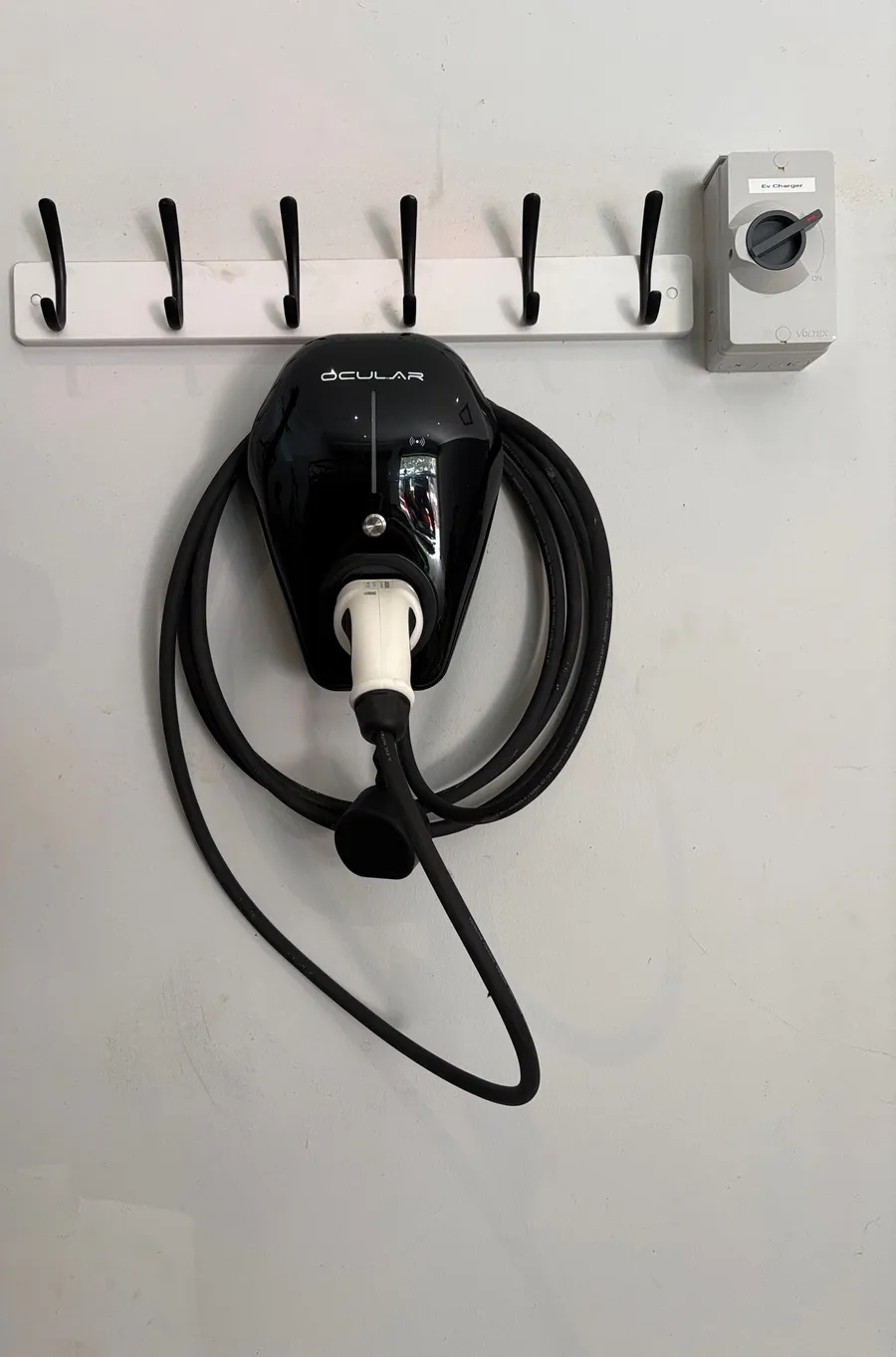
A home EV charger is a dedicated circuit from your switchboard to a wall unit in your garage or carport. Most Adelaide homes can take one, but the switchboard and the power supply decide how fast it can charge and whether anything needs upgrading first. We check both, fit the charger, test it and show you how to use it.
Over 20 jobs for home owners in the 12 months to October 2026 involved an EV charger.
Can my home take an EV charger?
Most houses can. A charger is a separate circuit with its own protection, so it does not share power with your lights and power points. What matters is whether your home has enough spare capacity to run it safely.
Three things decide this:
- The switchboard. It needs a free space for the new circuit and modern protection, including a safety switch. Old boards with ceramic fuses usually need upgrading first.
- The supply to your house. Homes have either single phase or three phase power. Most Adelaide houses are single phase, which is fine for home charging but sets a limit on charger size.
- The cable run. The distance from the board to the charger, and how the cable can be routed, affects the work involved.
A quick look at your board and meter is enough for us to tell you where you stand.
Single phase or three phase: what it means for charging
Single phase is the usual supply for a house. Three phase has more capacity and is found in some larger or older homes, and in homes that have had it added for big appliances.
In general terms, a single phase home can still charge an EV overnight, which is how most people use a home charger. Three phase can support a faster charger, but only if your car can accept the extra power. Many cars cannot, so a bigger charger is not always better.
Do not pay for more charger than your car and your supply can use. We will explain the options in plain terms and match the charger to your car and your house.
Some chargers are smart chargers. SA Power Networks describes these as chargers that can be set to manage the time and rate of charging automatically, for example to charge when a time-of-use tariff is low. If cheaper overnight power matters to you, ask whether the charger you are looking at can do this.
What an EV charger installation involves
- We inspect your switchboard, meter and where you want the charger.
- We confirm the charger size that suits your car and your supply, and agree the plan and quote with you.
- If your charger needs SA Power Networks approval, we lodge the application for you before it is installed.
- If the board needs work, such as a safety switch or a spare space, we sort that first.
- We run the cable from the board to the charger location, fix the wall unit and connect it.
- We test the circuit and the protection, then show you how it works.
Power is switched off for part of the job. Most of the work is in the garage and at the board, so there is little disruption inside the house.
Signs your switchboard needs work before a charger goes in
- It has ceramic fuses instead of circuit breakers.
- It has no safety switch, or the safety switch trips often.
- There is no free space for another circuit.
- It is cracked, scorched, rusted or noisy.
A charger can run for hours at a time at a steady load, which is more demanding than most household appliances. An old or crowded board is the most common reason a charger job grows. If this sounds like your home, read about our switchboard upgrades, and our guide on whether you need 3-phase power at home.
What to ask your electrician before you book
- Are you licensed? (Ours is SA electrical licence PGE 229 469.)
- Have you checked my switchboard and supply, or are you quoting blind?
- Which charger size suits my car and my house, and why?
- Does anything need upgrading first, and what is included in the quote?
- What happens if I move house or buy a different car?
Safety and compliance
An EV charger is fixed electrical work and must be installed by a licensed electrician. Plugging a car into a standard power point on a long extension lead is not a safe long-term way to charge.
SA Power Networks sets the rules for connecting chargers in South Australia. A charger that plugs into an ordinary 10 or 15 amp power point does not need its approval. A larger charger (SA Power Networks covers 20 to 32 amp chargers at most homes), rated above 20 amps on single phase or above 25 amps per phase on three phase, needs approval through the SA Power Networks online portal, and the application must be lodged before the charger is installed. Ask about this before you buy a charger, so you know which rules apply to the one you choose. When your charger needs approval, we lodge the application for you.
Planning ahead: a second car and your switchboard
Tell us what else runs on your supply, such as air conditioning or a pool pump, so we can check the board copes. If you might add a second EV later, we can leave room in the board so the next charger is easier to add. Our EV charger installation cost guide explains what affects the job. If the board needs a safety switch first, see our safety switch installation page.
Related services
Suburbs we cover
Master Electricians Australia State Excellence Awards




Lifetime workmanship guarantee
Our Reviews
Google Reviews
Fast, detailed and reliable workers! Eased my mind about concerns and were kind to my children when they were being annoying!
Read more of Tamika Koller's review on Google
Excellent service! Professional, efficient, and neat work. Very happy with the installation. Highly recommended!
Read more of Ronnelio Campana Jr.'s review on Google
Hoile Electrical arranged an electrician very quickly to review my smoke alarms. Ross was very friendly, efficient and helpful. Much appreciated and will definitely call them for electrical issues again.
Read more of Rebecca Davey's review on Google
Gerad arrived on time.spent a lot of time explaining the process of improving our air conditioning,would recommend him for your air conditioning needs, Craig
Read more of Craig's review on Google
Hoile Electrical were recommended to us and we can see why. Very quick and efficient service by James and Nathan. Excellent communication all the way through. The whole experience was faultless.
Read more of Brenda Jefferys's review on Google
Very professional and good at what they do.
Read more of Ross Todd's review on Google
Common questions
How much does it cost to install an EV charger?
It depends on the charger, the distance from the board and whether the switchboard needs work. We give a firm quote after we have looked at your switchboard and where the charger will go.
Does my EV charger need SA Power Networks approval?
Not if it plugs into an ordinary 10 or 15 amp power point. A larger charger (20 to 32 amps), rated above 20 amps single phase or 25 amps per phase on three phase, needs approval through the SA Power Networks portal before it is installed. We lodge that application for you.
Do I need three phase power for an EV charger?
No. Most homes charge happily on single phase, usually overnight. Three phase only helps if your car can use the extra power.
Can I just plug my EV into a normal power point?
Only as a short-term backup. A dedicated charger on its own circuit is safer and charges more reliably.
Does an EV charger need a safety switch?
Yes, the circuit needs proper protection, including a safety switch. If your board does not have one, we will add it.
Can you install a charger I bought myself?
Yes. Tell us the make and model when you book so we can check it suits your supply. It still gets its own circuit and protection at the switchboard, and we test it before we leave.
Call an Electrician
Competitive pricing to provide practical solutions to your electrical needs; Lifetime workmanship guarantee.